Strategy First: Start Your Sales and Marketing at the Beginning
Why jumping straight to tactics costs you time, money, and confidence - and what to do instead.
You wouldn't build a machine without a blueprint. You wouldn't pour concrete without surveying the ground first. Yet every day, SME owners skip straight to the 'doing' in sales and marketing - posting on LinkedIn, building a new website, running ads - without ever designing the system those tactics should fit into.
The result? Scattered activity, wasted budget, and the frustrating conclusion that 'marketing doesn't work for us'.
This year, start at the beginning. Strategy first, then plan, then tactics, then implementation. That sequence matters more than any individual tool or channel you choose.
The Planning Gap Nobody Talks About
The data is stark. A UK survey of nearly 2,000 SME decision-makers found that 54% of businesses don't have a documented business plan, and 67% don't have a marketing action plan. The researchers explicitly linked this to 'random acts of marketing' - activity without an integrated plan.
Our own survey of engineering companies at the Advanced Engineering Show confirmed this pattern. Only 48% had a formal marketing strategy in place - and that was at an exhibition where attendees already prioritise marketing more than the broader sector. The true sector average is likely much lower.
Why does this matter? Because companies with formal sales and marketing strategies were 110% more likely to report clear alignment between the two functions. Strategy creates a shared language and direction - the foundation for joined-up revenue generation.
The LinkedIn Trap: A Familiar Story
Let me paint a picture you might recognise.
You've been thinking about it for months. LinkedIn. Everyone says you should be on it. Your competitors seem to be posting regularly. So finally, you sit down one evening and create your first post. It feels awkward, but you do it. Then another. And another.
A few weeks pass. You're posting, but nothing's happening. No enquiries. No messages. The likes feel hollow.
So you watch some YouTube videos. Hours of them. You subscribe to a course. You learn about content pillars and posting schedules and hashtag strategies. You create a plan to roll this out properly over the next few months.
Three months later, still nothing. You give up. LinkedIn doesn't work.
Except it does work. Just not the way you were using it.
Fast forward a couple of years. You finally hire a marketing manager. They do something you never did: they start with strategy. They research your market. They profile your ideal clients. They map the buyer's journey.
And they discover something useful. Only a specific segment of your ideal clients actually use LinkedIn - and they only engage with it at a certain stage of their buying journey. Posting alone was never going to convert them. But LinkedIn's search function, InMail, and targeted connection requests? Those could work as part of a broader prospecting system.
All that time spent posting into the void could have been avoided if you'd started with the question: who exactly am I trying to reach, and where do they actually look?
The Seduction of 'Doing'
Here's the thing. Tactics are seductive. They feel productive. You can see a LinkedIn post. You can touch a new brochure. You can measure website traffic.
Strategy, by contrast, feels abstract. It doesn't produce anything you can hold. It requires thinking rather than doing. And for technically-minded business owners who've built companies through action, that can feel uncomfortable - even wasteful.
But here's what the data tells us. CoSchedule's marketing strategy research found that only 17% of marketers document their entire strategy, while 14% have no documented strategy at all. Of those who do plan, just 17% always proactively plan campaigns - the rest are winging it to varying degrees.
The Content Marketing Institute's B2B research shows the cost of this approach: 58% rate their content strategy as only 'moderately effective'. Just 22% say their content marketing is extremely or very successful. And crucially, where nobody 'leads as a strategic approach', teams default to reactive, scattershot tactics.
Here's the correlation that matters: among top performers, 74% say their content strategy is extremely or very effective - compared to just 29% overall. The research suggests a clear link between companies that strategise and those that succeed with their marketing. Strategy isn't overhead. It's the differentiator.
Random activity produces random results. That's not a marketing problem - it's a systems problem.
Marketing is More Than Promotion
Most people think marketing equals promotion. A post here, an ad there, maybe some SEO. But sustainable marketing runs much deeper.
Consider the 6Ps: Product, Price, Place, People, Process, and Promotion. Promotion is just one piece. Without clarity on the other five, your promotional efforts scatter - lots of noise, little impact.
Before you write a single post or design a single ad, you need answers to fundamental questions. Who exactly is your ideal client? What specific problems do they face? Why should they choose you over a competitor? Where do they actually look for solutions? What's their buying journey from awareness to decision?
Without these answers, you're firing into the dark. With them, every tactical decision connects to measurable outcomes.
The Right Sequence: Strategy, Plan, Tactics, Implementation
Think of building a bridge. You wouldn't start by ordering steel. You'd survey the terrain, calculate load requirements, specify materials, and design the structure before laying a single girder.
Sales and marketing work the same way.
Strategy: The Scoping Project (Your Redprint)
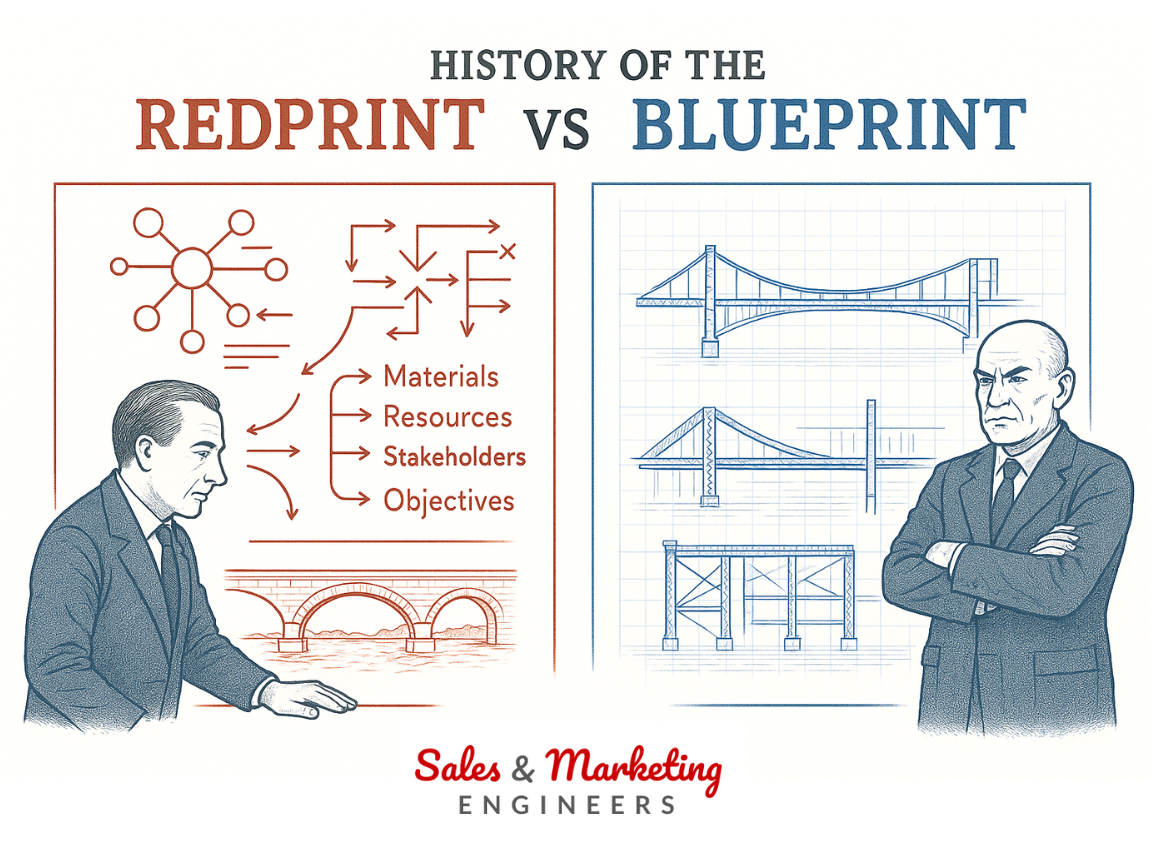
If your plan is the blueprint - the detailed design drawings - then strategy is the redprint: the scoping project that comes before any design work begins. It answers the 'why' and 'who'. It defines the parameters everything else must work within. This is where you survey the landscape, understand the constraints, and establish the foundations.
Plan: The Design Drawings (Your Blueprint)
Your plan translates strategy into specifics. Which channels will you use? What's your marketing mix? How do sales and marketing connect? What's the budget? What are the milestones? This is your engineering specification - the detailed drawings that guide construction.
Tactics: The Components
Tactics are the individual activities - the LinkedIn posts, the website pages, the email sequences, the sales calls. Each one should serve the plan, which serves the strategy. Without that connection, tactics become random acts of marketing.
Implementation: The Build
Implementation is where the work happens - consistently, systematically, with measurement and refinement. But note where it sits in the sequence. Last, not first.
What Your Strategy Should Actually Include
So what goes into a proper marketing strategy? Here's the framework, broken into five essential sections.
1. Research: Survey the Landscape
Before you can position your business or choose your channels, you need to understand the terrain. This is the foundation everything else builds upon.
- Market Analysis - Industry trends affecting your sector: what's growing, what's declining, what's emerging
- Competitive Analysis - Who's doing what well and not so well, and where the gaps lie
- Audience Profile - Your ideal customers, partners and stakeholders, their challenges and desires
- Customer Buying Journey - The acquisition funnel (how they find and choose you) and the retention funnel (how they stay and refer)
2. Positioning: Define Your Place in the Market
With research complete, you can make informed decisions about how to differentiate and present your business.
- Business Plan Alignment - Your high-level 3-5 year objectives that marketing must support
- Offering Clarity - Your services and products, and which to prioritise based on demand and margin
- Value Proposition - Your USP, taglines, and elevator pitch that capture why you're different
- Market Positioning - Where you sit competitively: specialist vs generalist, premium vs value
- Style and Tone of Voice - The personality and language that resonates with your audience and sets you apart
3. Go-to-Market: Choose Your Channels and Campaigns
Now you can decide where and how to reach your audience - based on evidence, not assumption.
- Marketing Mix - Which channels align with where your audience actually looks
- Outbound vs Inbound - The balance between prospecting and attraction for your sales cycle
- Campaign Types - Awareness, lead generation, nurture, and retention campaigns
- Asset Requirements - The website pages, content, collateral, and sequences you'll need
4. Plan: Resource and Sequence Your Implementation
Strategy without a realistic plan stays on the shelf. This bridges strategy to action.
- Resource Assessment - Time, people, tools, and partners: what you have and what you need
- Budget Allocation - Total investment and how it splits between setup and ongoing activity
- Implementation Sequence - What to build first, with dependencies mapped
- Timeline - Quarterly milestones, monthly priorities, and clear ownership
5. Continual Improvement: Measure, Learn, Refine
Marketing is never 'done'. This establishes how you'll iterate and improve.
- Experimentation Framework - How you'll test new channels, messages, and offers
- Analytics and Measurement - Tools, dashboards, and reporting cadence
- Key Driving Indicators - Leading indicators (traffic, enquiries) and lagging indicators (conversions, revenue)
- Review and Adaptation - Scheduled strategy reviews and triggers for course correction
Can AI Write Your Sales and Marketing Strategy?
Can you have your strategy written by AI? Hell no. But can it assist you?
Absolutely.
Strategy sits at the intersection of research and future projection. AI can accelerate much of the research - market trends, competitor analysis, audience insights, channel options. It can help you assess alternatives, stress-test assumptions, and explore scenarios you might not have considered. For the analytical heavy lifting, it's a genuine multiplier. But it needs a good steer!
But here's what AI cannot do: it cannot understand the nuances of your business, your relationships, your ambitions, or your constraints. The overall direction - where you're heading and why - needs to be discussed, debated, and chewed over by the people who actually run the business. Strategy isn't a document you generate; it's a position you arrive at through genuine deliberation. That's what transforms generic frameworks into a tailored approach that fits your specific situation.
The way AI and human thinking need to weave together is an art, much like strategy itself. And this brings me to a broader point I've seen play out time and time again: marketing strategy cannot be left to one person alone. Yes, someone may champion it, drive it forward, and hold the pen. But good strategy is important enough to be baked into the culture and leadership of the company. When strategy lives only in the marketing manager's head - or worse, in a document nobody else has read - it fails to align the business. When it's genuinely owned by leadership, debated in meetings, and referenced in decisions, it becomes the compass that keeps everyone moving in the same direction. See our AI services if you need help with a holistic plan from auditing, training to structured case studies and full implementation.
What This Means for Your Business
If you're reading this as an MD, Commercial Director, or Operations Director, here's the practical takeaway.
Before you commission that new website, before you hire that marketing person, before you launch that LinkedIn campaign - ask yourself: do we have a documented marketing strategy?
Not a plan. Not a list of activities. A strategy. One that defines your ideal client profile, your competitive positioning, your value proposition, and how sales and marketing will work together as one revenue engine.
If the answer is no, start there. Everything else can wait.
The time you invest in strategy upfront will save you months of scattered activity, wasted budget, and the frustration of wondering why nothing seems to work.
Engineer Your Growth
Your technical operations run like clockwork because you engineered them that way. Your revenue generation deserves the same precision.
Strategy first. Plan second. Tactics third. Implementation fourth.
That's not just a sequence. It's the difference between building a proper system and hoping for rain.
But here's the difference - writing your own strategy is hard. Not because you don't know your business, but because you know it too well. You're inside it every day. Internal biases creep in. Assumptions go unchallenged. You end up running in circles, too close to see the full picture.
That's where outside help makes the difference. Not someone to "do it" for you - strategy that lives in an agency's folder isn't strategy at all. But a third party who can facilitate the process, do the research heavy lifting, ask the uncomfortable questions, and help you look at your business from the outside in. Someone who can guide the conversation, challenge your thinking, and then help bake the strategy into your leadership team so it actually sticks.
The best strategies aren't handed over in a PDF. They're built collaboratively, debated properly, and owned by the people who have to execute them.
This year, start at the beginning. And if you need a hand getting there, don't go it alone.
Ready to build your strategy? Book a free strategy audit and let's engineer your growth properly - together.
Written by Stefan Buss - Industrial Engineer and Founder of SME